Shell Shocked
Jessica Valek exemplifies the Emerald Coast’s passion for sea turtles
Spend enough time around Destin and Fort Walton Beach, and you will probably meet Tina.
Tina is a bit of a celebrity around the area, showing up at parades, visiting classrooms, talking it up with vacationers and anyone else. To little ones, she is by far the biggest turtle they have ever seen. To adults, she is the face—and shell—of sea turtle awareness and conservation along the beach.
When Jessica Valek puts on her “Tina the Turtle” costume, she says she becomes the happiest turtle you will ever meet. “I wave at everyone,” she says. Valek is the natural resources manager for Okaloosa County and heads up the Destin-Fort Walton Beach Sea Turtle Patrol a group that patrols the beaches at sunrise during turtle nesting season, which spans May 1 to October 31. Her office is filled with stuffed toy turtles on shelves and pictures of turtles on the wall. She owns three turtle suits.

Photos by Mike Fender
In her role as Tina, she spreads the word about not using lights on the beach at night during nesting season, what to do if you find a stranded or injured turtle, and a crash course on everything to love about the flagship species.
When Valek, 33, started her job five years ago, she immediately found herself embedded in a community wild about sea turtles. While her position also deals with invasive lionfish and other marine animals, it is the people’s love affair with turtles that takes up most of her attention.
“I don’t know what it is,” says Valek. “Maybe it’s because they are so helpless,” she says with a smile. “People love dolphins, but not the way they love turtles. They are a cute, little, almost cartoon-like character of an animal,” she says. “I mean, it’s hard to imagine a sinister little sea turtle, right?”
With advocates like Valek and hundreds of others along the Panhandle (and other Florida beaches), things are looking up for sea turtles. While still protected, the Florida Fish and Wildlife Conservation Commission (FWC) reported exceptional numbers for turtle nests in Florida from 2025 surveys.
Leatherbacks set a new state record with over 2,012 nests, eclipsing the previous record of 1,848 in 2022. Green turtles had their second-highest season ever with 66,476. Loggerheads, the dominant turtle in the state, counted 100,951 nests, and Kemp’s Ridleys, the rarest turtle in the state, had 12 recorded nests with 21 more pending genetic confirmation.

Photos by Mike Fender
Valek and her group of turtle watchers count about 20 nests a year in the area they patrol. A count of 46 more were recorded on Eglin Air Force Base property. Escambia County surveyed 114 in the FWC numbers. Walton County had 68, Bay County 240, and Gulf County 670.
Sea turtle nests average between 80 and 120 eggs each. Despite impressive numbers, the odds of a hatchling making it to adulthood are slim. The FWC estimates only about one hatchling for every 1,000 eggs will actually survive. And some other estimates suggest the chances are even poorer.
A combination of factors lead to the hatchlings’ demise. Predators like birds, crab, and fish consume many of the small creatures after they hit the water. Some don’t make it to the water because of light pollution on the beaches, which leads the turtles to become disoriented and head away from the water. For others, it will be pollution in the ocean, like ingesting plastic debris or becoming entangled in trash and fishing line. And some nests fail to hatch due to storm washouts.
With these low odds, it is often celebratory when people do see a sea turtle or even a nest, says Valek. Her turtle watch group consists of her and 24 volunteers. This year, when she posted about available spots within the group, she received over 200 applications in the first 48 hours. And most of her team comes back year after year.
For Valek, who grew up in Minnesota, getting up early every day during nesting season is exciting. “I get to see the sunrise every morning. It’s a good way to start the day,” she says. She still remembers seeing her first nest on patrol a few years ago while out with a new volunteer.

Photos by Mike Fender
“I started screaming,” Valek says. “And she started screaming. We got out of the vehicle and were hugging each other, jumping up and down.” Valek says she still gets that excited today when she finds a nest, even when she is out by herself.
While on patrol, Valek looks for telltale signs of a crawl. Usually, this looks like something has been dragged along a flat area in the sand, with flipper marks on both sides. “You just follow the trail from the water,” she says. “And hopefully it leads to a nice, fluffy pile of sand.” But not all drag marks are turtles, Valek says. Sometimes it can look similar when beachgoers drag a cooler off the shore.
When she finds a nest, she will mark it with stakes and orange tape, adding a warning sign. She checks the nest every day, looking for signs the eggs have hatched and that the hatchlings have crawled toward the water. After nests have hatched, Valek and her team will excavate the nest and count the hatched eggs to determine a success rate. To perform this work, Valek holds a permit from the Fish and Wildlife Commission (FWC).
Even outside of nesting season, turtles are always a concern for Valek. She responds to calls for help when people discover injured or cold-stunned turtles. In our area, turtles are often injured by entanglement and ingesting fishhooks as well as boat strikes.
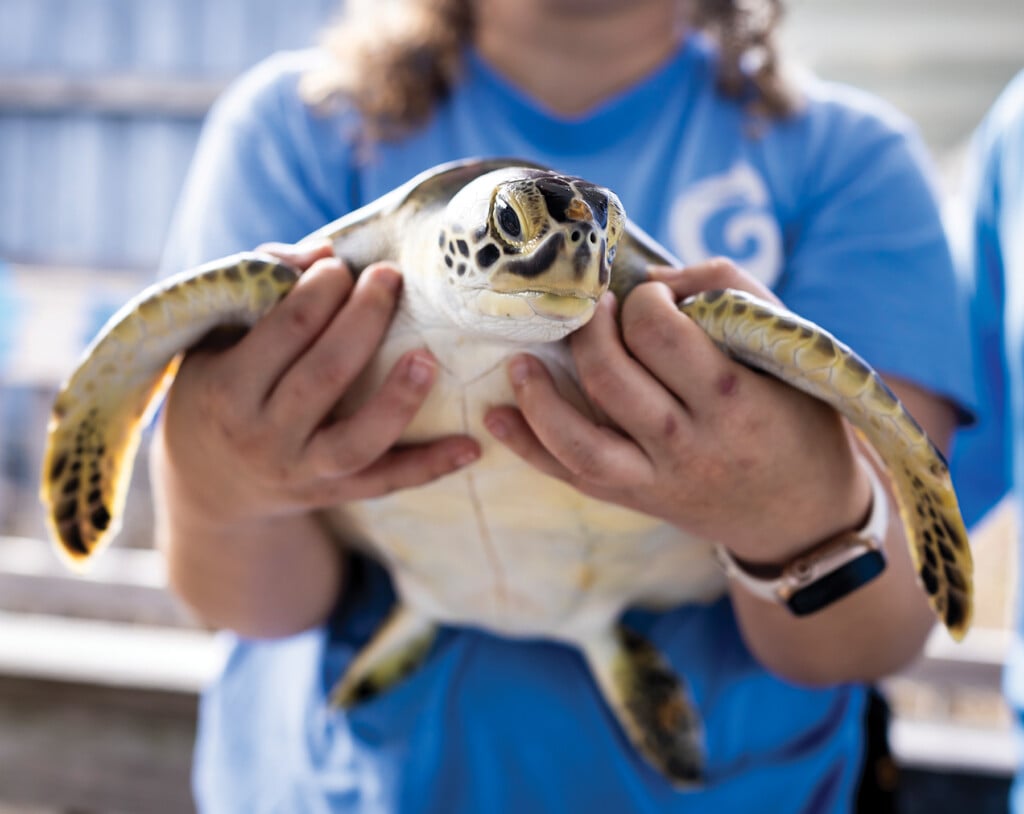
This winter, Valek received a call from the FWC about a turtle acting lethargic in Destin’s Kelly Plantation. When she got there, she discovered a young Green turtle lying on the sea floor a few feet from shore, obviously in distress. She picked up the turtle—the size of a large dinner plate—and transported it in the back of her car to the turtle rehabilitation facility at Fort Walton Beach’s Gulfarium.

Photos by Mike Fender
The Gulfarium C.A.R.E. Center (Committee on Animal Resources and Education) is an FWC-permitted, nonprofit facility with a mission to rescue and rehabilitate injured or sick sea turtles.
According to Patrick Berry, president of the Gulfarium C.A.R.E. Foundation, the rehab is a sister facility to the Gulfarium Adventure Park. Established in 2015, the center now sees over 100 turtles a year. Some are rescued locally, but others come in from elsewhere on the East Coast and all over Florida.
Here, the recovering turtles are housed in large round pools. There are eight of them: seven of which are 12 feet in diameter and one larger 20-foot pool. The on-site medical center offers everything from X-rays to surgeries, and turtles are monitored around the clock in a hospital-like environment.
“We like to call ourselves stewards of the environment and stewards of the species that can’t help themselves,” Berry says.
When the turtle Valek rescued came to the rehab center, he was diagnosed with pneumonia in addition to being cold stunned. At the center, they named him Taki; yes, after the spicy rolled tortilla chips. Taki shares the center with Ruffles, Blaze, and Pringle.
On a recent visit to the center, Valek met up with the Gulfarium’s assistant stranding coordinator, Sarah Kamen, who was taking care of Taki. Valek watched as Taki was prepped for X-rays and had his vitals recorded. He wasn’t too fond of standing on the X-ray platform.

Photos by Mike Fender
After a visit from the center’s veterinarian, Dr. Julie Cavin, Taki’s chart says, “He is bright, alert, responsive, and making great strides in his recovery process.” Fluids and vitamins are being discontinued because he is eating and swimming well.
The end goal for every rescue is to see the turtle released back into the Gulf. Kamen says Taki is still a month or two away from making his way back home.
“Once they have been fully discontinued from medical treatments, they go through a one-month ‘wash-out’ period to ensure that they stay stable before release. With Taki still being on antibiotics, it could be two months or more, depending on how his bloodwork looks following each recheck,” Kamen says.
One thing is for sure: When Taki goes home, he will not be alone. Turtle releases are increasingly drawing large crowds of residents and tourists. Numbers in the hundreds are not unusual. Adults and children line a long path to the ocean as the turtle is carried to the water’s edge. From there, Taki will crawl the rest of the way into the water on his own and swim away as the crowd cheers.
Kamen will be there, and Valek hopes to be as well. Even an appearance by Tina the Turtle is possible. “The passion for sea turtles here is just insane,” says Valek.
“I love being a part of it.”