Into the Woods
Arix Zalace’s cinematic journey with Florida’s black bears
At first light in a Walton County forest, the air hangs damp and cool, heavy with the scent of pine and palmetto. A white-tailed deer slips through the trees. Somewhere overhead, a woodpecker taps. A father kneels in the sand, framing his camera shot while urging his son to look up and watch the sky flush pink above the longleaf canopy instead of the glow of a cell phone screen.
This scene opens The Paper Bear, a new feature-length documentary from Santa Rosa Beach filmmaker Arix Zalace, mirroring Zalace’s own lifelong connection to the Panhandle.

Photos courtesy of Arix Zalace-The Paper Bear
The film blends sweeping live-action wilderness footage with hand-drawn animation to tell a conservation narrative rooted entirely in Northwest Florida, where Zalace grew up. It follows a father and son into the backcountry, where the boy listens as his father finishes the tale of a band of black bears sworn to protect the forest. Through that story, Zalace explores the region’s ecological and cultural history.
In 2016, the global scientific community designated the North American Coastal Plain as the planet’s 36th biodiversity hotspot. Stretching from the Rio Grande to Martha’s Vineyard, it makes up just 2.5 percent of Earth’s land mass yet contains more than half its plant and animal species. The epicenter lies in the Florida Panhandle. Walton County’s population hovers around 70,000 to 80,000 residents, but millions of visitors arrive each year. Many fall in love with the beaches and decide to stay, often unaware of the deeper ecological story beyond the dunes.
To tell that tale in a way that felt accessible, Zalace chose the black bear as his guide. “If you can get people to fall in love with an umbrella species,” he says, “they’ll care about everything under that umbrella.”

Photos courtesy of Arix Zalace-The Paper Bear
In the film’s animated arc, a cub named Max grows up, loses his mother, and drifts toward neighborhoods, illustrating how bears become dependent on human food and how fragile the balance between forest and suburb can be.
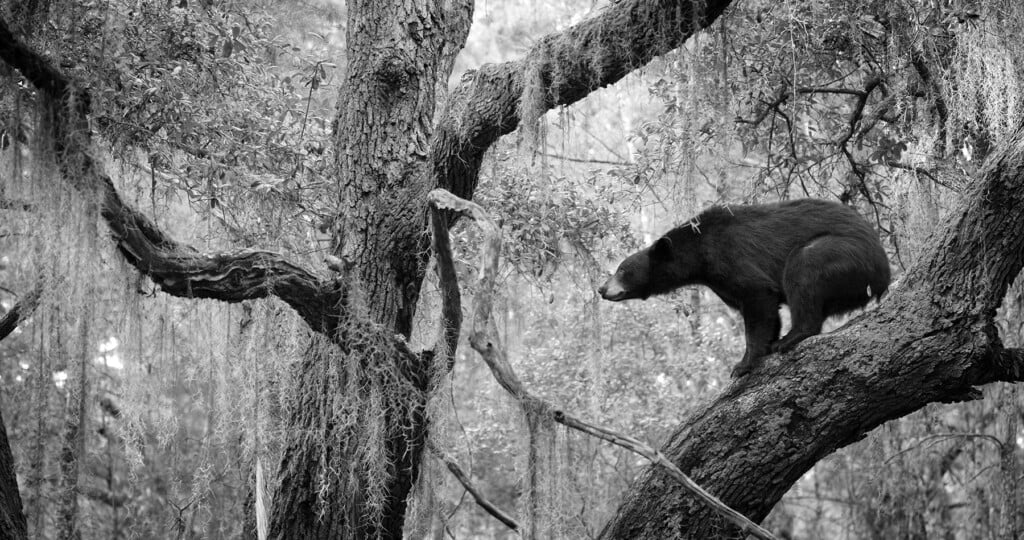
Capturing the real bears, however, proved far more demanding than Zalace anticipated. What he imagined might take a month became a two-and-a-half-year immersion in the woods. He set strict rules for himself: Never stand tall in front of the bears, never speak human language around them, never alter their behavior, and always wear a ghillie suit to soften his presence.
“I basically had to create my own system,” he says. “Nobody had done this before in this way.”
Months into filming, a young female bear emerged behind him as he adjusted a tripod. She froze. He froze. After a tense pause, she bolted, then circled back, curiosity overcoming fear. Zalace later named her Tala. He followed her for a year, learning her patterns. When she disappeared for months and finally returned, she stepped aside to reveal a tiny cub.

Photos courtesy of Arix Zalace-The Paper Bear
For the next year and a half, Zalace documented Tala and her growing cub, footage that forms the emotional backbone of the film. “It was life-changing,” he says. “[Even] if no movie had come out of it, I’d do it again in a heartbeat.”
Animation became essential for telling the heavier chapters of the Panhandle’s past—from Indigenous displacement to the clear-cutting that decimated forests for more than a century. By shifting into a hand-drawn world, Zalace and his team explored history in a way children and adults could watch together. The result feels less like a lecture and more like an adventure, part family saga, part ecological awakening.
Ultimately, The Paper Bear is as much about legacy as it is about wildlife. It opens and closes with a grandfather’s journal and with two young Maxes—a bear and a boy—poised to inherit the future. For Zalace, the goal is simple: that viewers leave with a deeper understanding of the place they call home, or the place they’ve come to love. And sometimes, that starts with looking up at sunrise and listening to a story.
The film will be available to stream on Amazon Prime Video and AppleTV May 18. For information about theatrical screenings, including a viewing at the Mattie Kelly Arts Center on June 20, visit thepaperbear.org/theaters