Sunken Treasure
Hollywood’s most famous pirate ship is yours to explore
Most of us will never star in a Hollywood production, but a few miles off the coast of Panama City Beach, you don’t need to be an A-lister to grace one of Disney’s most iconic movie sets—you just need a Scuba certification.
That’s because the Black Pearl, the very ship from the Pirates of the Caribbean franchise, was recently sunk six nautical miles southwest of St. Andrews Pass. Once Captain Jack Sparrow’s pride and joy, the 97-foot steel-hulled ship now serves as the area’s latest artificial reef and is open for certified divers to explore.
After its time in the limelight, the Black Pearl lingered in Bayou La Batre, Alabama for years until Visit Panama City Beach purchased the vessel. The ship was rid of hazardous materials, prepped as a reef, towed to its current location, and submerged, with the entire project costing $165,000.

Photos by Romona Robbins Photography
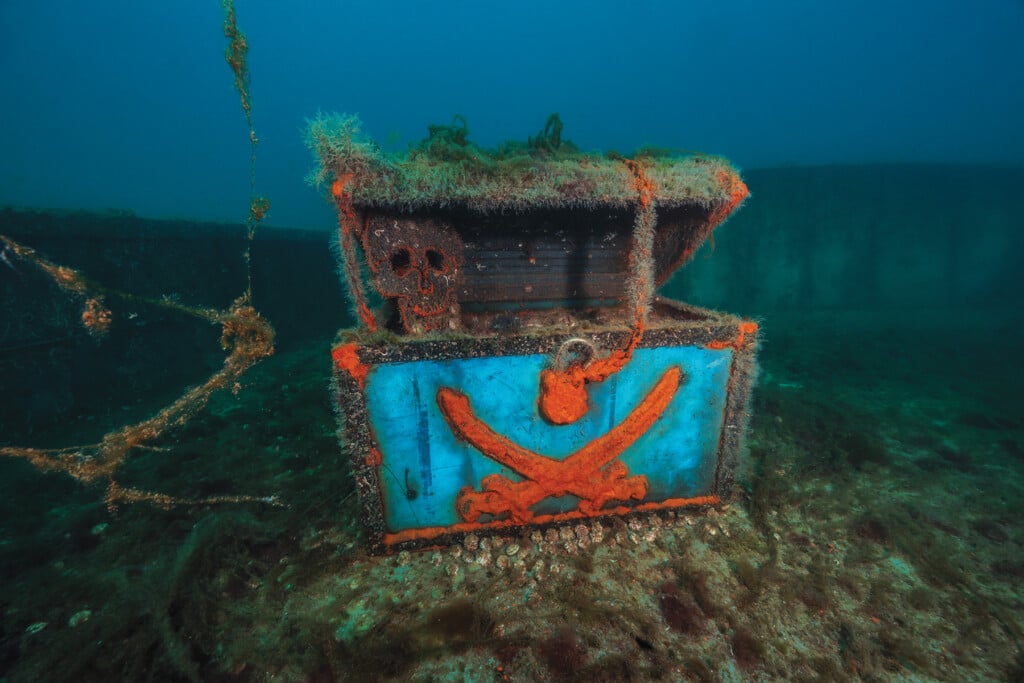
Before it was sunk, students from Haney Technical College even crafted and installed several pirate-inspired elements, including cannons, a treasure chest, a plank, and a welded flag, that will simultaneously add to the dive experience and support long-term reef development.
The Black Pearl’s arrival on the Emerald Coast isn’t just boosting the local economy or providing another avenue to experience Florida’s great outdoors: It is also serving an important ecological purpose.
“Artificial reefs play an important role in enhancing marine habitat in areas of otherwise flat, sandy bottom. They create structures that support feeding, spawning, and shelter for a wide range of species,” explains Erin Graham, the artificial reef coordinator for Panama City Beach.

Photos by Romona Robbins Photography
According to Graham, ecological monitoring of other local artificial reefs like the Black Bart and Twin Tugs has documented thriving ecosystems across multiple trophic levels, from plankton-feeding baitfish to larger predator species such as grouper and snapper.
Based on the success of those projects, Graham expects the Black Pearl will develop into a vibrant, biodiverse reef system in the coming years. Early monitoring conducted just one month after the ship’s deployment has already recorded the presence of marine life, including sharpnose puffer, red snapper, and juvenile greater amberjack.

Photos by Romona Robbins Photography
Getting Your Sea Legs
The Black Pearl is submerged in approximately 75 feet of water, and those interested in diving deeper than 60 feet will need to obtain an Advanced Open Water certification.
However, an Open Water Diver certification allows divers to explore as deep as 60 feet. At that depth, divers can still comfortably experience the ship’s masts, upper and main decks, as well as Haney Technical College’s interactive additions.
There are no additional requirements or waivers required, as the reef is open access and designed for the public, provided divers meet the appropriate certification level for the intended depth.
Getting There
The Black Pearl can be accessed by private or for-hire boats. For those planning to dive the site, booking through a local dive shop is recommended. More information and a list of reputable local dive operators are available at
visitpanamacitybeach.com/artificial-reef under the “Snorkeling & Diving” section.