Dots, Craks, Bams
Notes on the mahjong revival
All across the Emerald Coast, a familiar sound is catching on. It’s the rhythmic click of mahjong tiles heard around kitchen tables, in community centers, and at restaurants or beachside venues. Once dismissed as a pastime for grandmothers, mahjong has reemerged as a vibrant cultural phenomenon, drawing in players of all ages.
Mahjong (also spelled mahjongg or mah jongg) originated in China in the 1800s and has evolved into several forms, most notably Chinese and American styles. In the United States, American mahjong dominates, guided by the standardized system established by the National Mah Jongg League (NMJL) in 1937. Each year, the league publishes an official card that lists the winning hands for that year. More than a reference, the card, which retails for about $15, is the heart of the game, pushing players to adapt, relearn patterns, and rethink strategy.
For newcomers, the game looks complicated and intimidating, and the official card can appear chaotic. However, devotees and instructors like Sue Tarkin of Niceville insist anyone can learn to play. “It’s a fun way to keep your brain engaged and be with old and new friends,” Tarkin says.
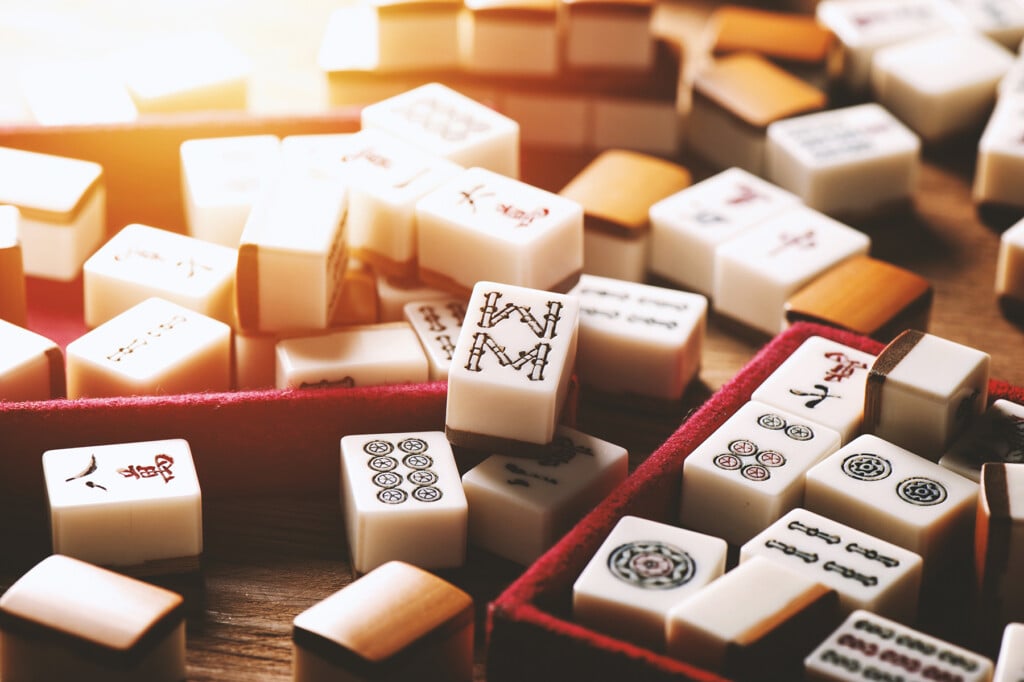
The game uses 152 stylized tiles, including jokers, flowers, winds, and dragons, along with three suits called bams (short for bamboo), craks (short for character), and dots. Mahjong also has its own vocabulary, including NMJL-specific terms such as quint and sextet.
Mahjong is played with four players seated around a table, each building a hand by drawing and discarding tiles. The goal is to match one of the combinations on the official card and be the first to complete a 14-tile winning hand called mahjong. The game can move quickly, with a constant stream of decisions, and every draw, discard, and defensive move capable of shifting the outcome.
For players like Debbie Crandall of Niceville, that challenge is part of the appeal. “I am a retired math teacher,” she says. “I love figuring out the patterns and trying to choose the best hand.”
Some describe mahjong as harder than Rummikub, easier than bridge, but just as addictive. Alongside chess and bridge, it remains one of the few games where players often seek formal instruction to learn how to play.
Most beginners can learn the basics in a few sessions, though mastery takes longer as the rules can be nuanced. That growing interest has fueled a wave of local instructors and clubs.
“I ended up starting to teach the game because I was trying to find people in the area who play,” says Jennifer Marvel, founder of Beach Mahj™️30A.
What began as a small gathering for Marvel quickly gained momentum. “I started teaching a handful of people in my home,” she says. “Within a year, I had taught hundreds of people along the 30A corridor.”
As demand grew, Marvel recognized the need for support and brought on assistant Jessica Tamer, training her to help meet the surge in interest.
“I don’t like to deliver it all in one lesson,” Marvel explains, “because I don’t think it lands well.”
Instead, she developed a structured progression—Mahjong 101, 102, and “Lifeguard on Duty,” which is a guided play session with other beginners. More advanced sessions focus on speed and strategy, with some players eventually moving on to compete in tournaments.
To further build community, Marvel founded the Beach Mahj Social Club, which hosts private parties, corporate events, charitable fundraisers, and retreats.
Marvel is not alone in fueling the game’s resurgence. Other mahjong enthusiasts like Lisa Hammond of Niceville are seeing similar growth. Hammond launched the Niceville Tile Society and offers Mahjong 101 and 102 classes to help new players build confidence and skill. Her classes have expanded so rapidly that they’ve already outgrown their original space. She also hosts events.
Open-play gatherings draw both men and women spanning a wide range of ages and backgrounds. “People want connection,” says Hammond. “They want to get away from their screens and be engaged.”
That desire has only intensified since the COVID-19 pandemic. For many, weekly games provide structure, continuity, and friendship.
For Pam Marcum of Niceville, mahjong became a turning point after she found herself increasingly isolated after her husband’s death. What began as a simple invitation to play led to friendships and a renewed social life.
Even the look of the game has evolved. Today’s sets range from traditional heirloom tiles to bold patterns and modern, playfully themed designs. In that way, the game feels both nostalgic and newly fashionable.
One thing is constant, though—the inevitable question after someone yells mahjong and shows their winning hand … “Should we play one more?”