Heavy Layers
Justin Gaffrey’s lifelong pull toward the spaces in between
I step off the dirt parking lot just off 30A and onto a mosaic path. Native plants brush the walkway’s edges. A massive tree throws dappled shade across the property, where three paintings framed inside wooden pavilion structures form a loose fence between the gallery and the road. A bicycle—long retired from riding—has been transformed into an art object and leans nearby, holding the open sign.
Before you ever touch a canvas, this place tells you what it is: not a white-box gallery, not a showroom, but something lived-in. Something layered. The former home of artist Justin Gaffrey opens room by room, into a space where art spills across walls, furniture, and floors—and where visitors are encouraged not just to look but to linger, photograph, and even touch the work.
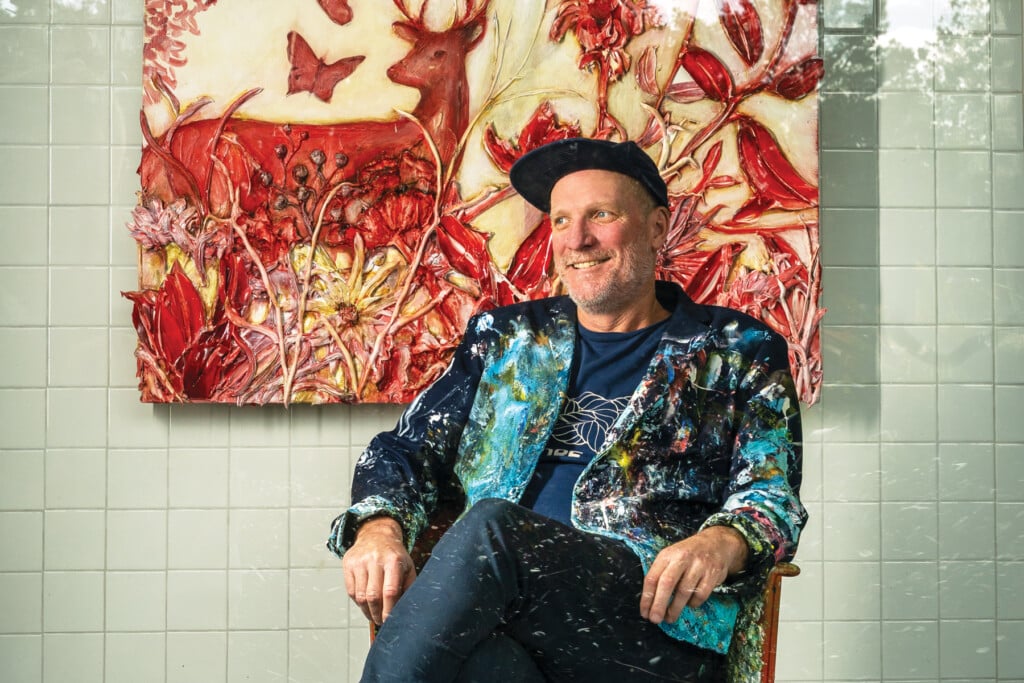
Inside, comfy boucle chairs sit grounded among large-scale paintings and mixed-media sculptures from Gaffrey’s Liminal series. Thick paint rises from the canvas surface. Metal pierces through pigment. Swamps, forests, garden gnomes, deer, and alligators exist somewhere between folk art and dreamscape.

Photo by Sean Murphy
“I wanted to turn it into an art house,” he says of the space, where he once raised his children. “A place that feels alive and usable. This was the kitchen where we had parties and happy hours, where I cooked all the meals for our family.”
One piece pulls me in immediately: a large canvas of blue flowers accented with bits of metal sculpture, layered whites shifting from gold to ivory. Next to it hangs a red painting—squirrels tucked into a leafy tree in the foreground, a Piggly Wiggly floating quietly in the distance. The surface is alive. Leaves protrude, paint piled so thick it feels grown rather than applied.
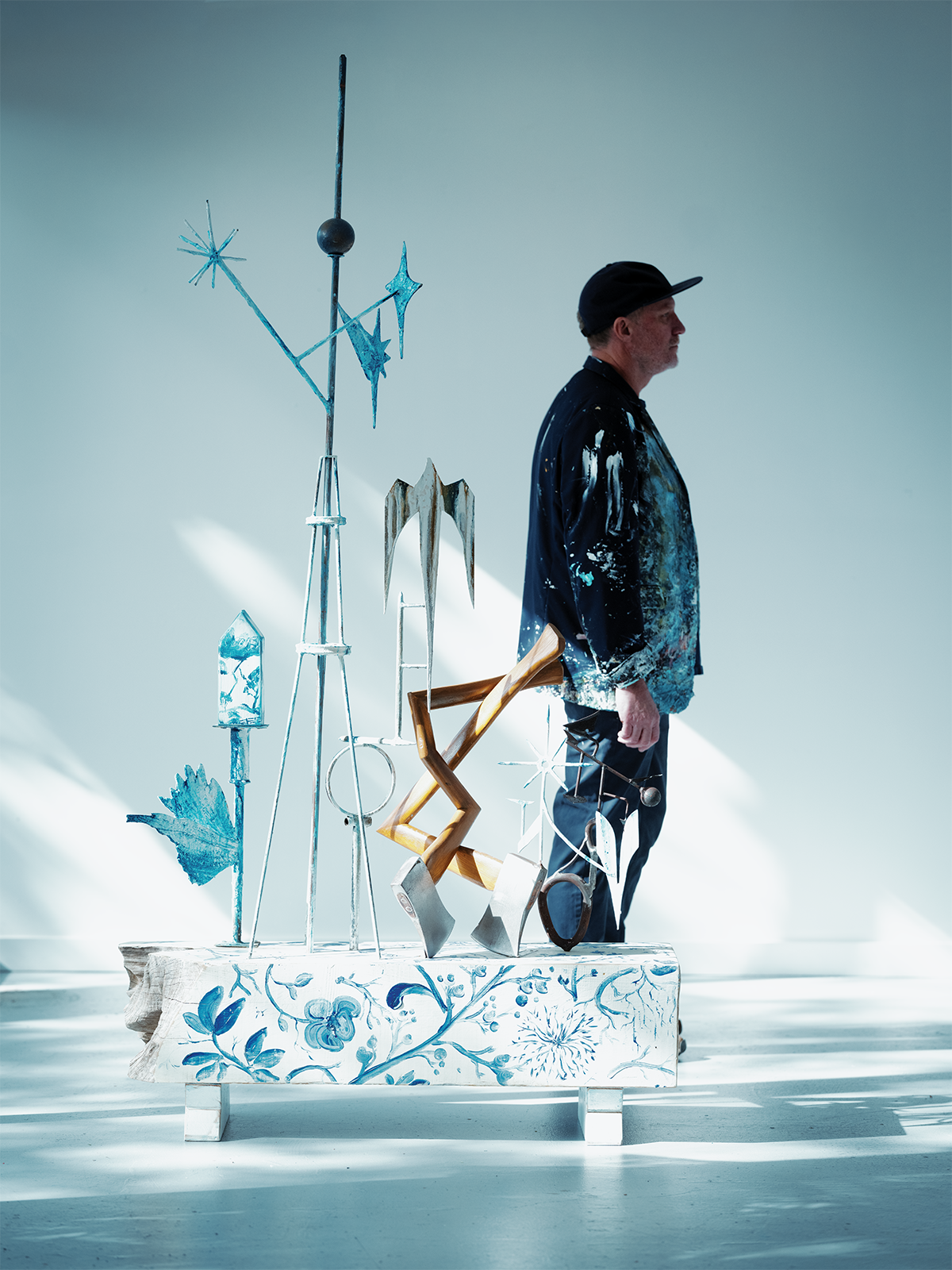
Across the room hangs the work that launched the Liminal collection: a pitchfork sculpture twisted into a frame, its tines pointing downward. Inside that window, a blue-and-white scene unfolds—horse and rider, cow, rabbit, bird—shards falling from the fork’s body outside the window. Nearby, another vignette features squirrels rendered in blue tones reminiscent of vintage Blue Willow dinnerware, a Jiffy cornbread box tucked beneath one small foot.
Each scene hums with nostalgia—folk art, Southern iconography, memories half-remembered. Like his art, Gaffrey calls this space liminal: the threshold between what was and what is, between fable and reality.
“It all started because I just needed something different to do,” he says. Last summer, wandering through an antique store, he became fixated on an old pitchfork.
“There was something about it that was just calling my name. They wanted $100 for it, and I said, ‘I’m not paying $100 for an old pitchfork,’ but it stuck with me. I kept thinking about it.”
Eventually, he bought it. On the drive home, he stopped at the hardware store for a thick dowel rod, reshaping the handle into something surreal, something deconstructed and reassembled. Still, he didn’t know what the piece would become until he began researching the mythology of pitchforks. “Before machinery, pitchforks were used to separate wheat from the chaff,” he says. “And in that moment, when they separated it, it became tangible. Before that, it was still kind of a myth; it existed in the mind. I loved the idea of that space between the myth and reality.”
That in-between space became the conceptual backbone of Liminal. As the series evolved, it expanded outward—into welded metal, found objects, and personal memory. Patterns from his childhood surfaced unexpectedly. Familiar brands like Piggly Wiggly and Waffle House appeared, chosen for their universality as much as their Southern roots.
“There are memories I have now that I don’t know if they’re real anymore,” Gaffrey says. “I’m curious about that space—between present and past, between memory and truth. That still feels unfinished to me.”

Photo by Sean Murphy
Texture has always been Gaffrey’s language. Trashcan-sized buckets of white paint sit ready in his studio. He pipes color like icing, loading white paint over lines of pigment so when it hits the canvas, it creates wild striations and movement. Sometimes he mixes directly on the canvas, sometimes on a palette. Often, he finishes with a palette knife, swooping color across thick white paint.
“I’ll always paint texture,” he says. “I have so much muscle memory built into it. It’s really difficult to abandon.”
That muscle memory comes, in part, from a former life as a chef. Gaffrey grew up in the area and moved out at 16, when restaurant work was one of the few options available. A chance moment as a busboy changed everything. He owned and sold a restaurant by age 30, realizing he loved food but not the restaurant business. Later, building furniture led him back to painting—first on wood, then on canvas. A primitive painting of skeletons at a cookout sold immediately. “It was good enough for somebody to buy,” he says. “Then I did another one. And another one.”
The gallery upstairs still shows evidence of that work ethic: paint-splattered floors, furniture marked by explosive swaths of color, rows of boots from live painting sessions. A navy blazer hangs on a mannequin, stiff with dried paint—worn during live performances where the act of painting becomes its own form of spectacle.

Photo by Sean Murphy
When Gaffrey talks about landscape painting, his voice slows. “I’m walking right now—out near my house, off Hogtown Bayou,” he says. “It’s probably the most beautiful spot in our area, outside the river. There’s no development. It’s pure Florida.”
It’s where he walks his dog, where the water opens up, and the land remains largely untouched. The stillness feeds directly into his work. “I paint landscapes because they’re very soothing,” he says. “I can make them up as I go along, just from memory.”
Those landscapes—dense clouds over Western Lake, an alligator slipping quietly into water, otherworldly flowers reaching toward the horizon—form the foundation of his practice. But comfort alone isn’t enough. “I need to challenge myself sometimes,” he says. “That balance between what’s easy and what’s uncomfortable, that splits my time about half and half.”
These days, Gaffrey is looking ahead. His children, Aria and Justin Jr., run Gaffrey Art Material, a heavy-texture acrylic paint company born during COVID-19. They’re artists themselves, working alongside their father. Gaffrey is rebuilding a welding studio, preparing to return to large-scale sculpture inspired by artists like Alexander Calder.
Gaffrey’s work resists closure—paint piled thick enough to cast shadows, metal protruding through pigment, memory and myth sharing the same surface. It exists in the place where something hasn’t fully become what it’s going to be. Whether it’s a pitchfork bent into a frame, a landscape recalled from a quiet walk along Hogtown Bayou, or a new sculptural form still taking shape in his mind, the work remains animated, usable, alive.